Home Tour: A Sarasota Midcentury House, Built for Continuity
Beth Helvey December 18, 2025
Beth Helvey December 18, 2025
Light moves across the terrazzo floors, slipping under furniture legs and settling against a low brick half-wall near the entry. Palms and bamboo outside hold steady between gusts. Nearby, planes arrive and depart as part of the ambient rhythm of the neighborhood. The house itself remains grounded: one story, wide and unhurried, built for people who come together and stay awhile.
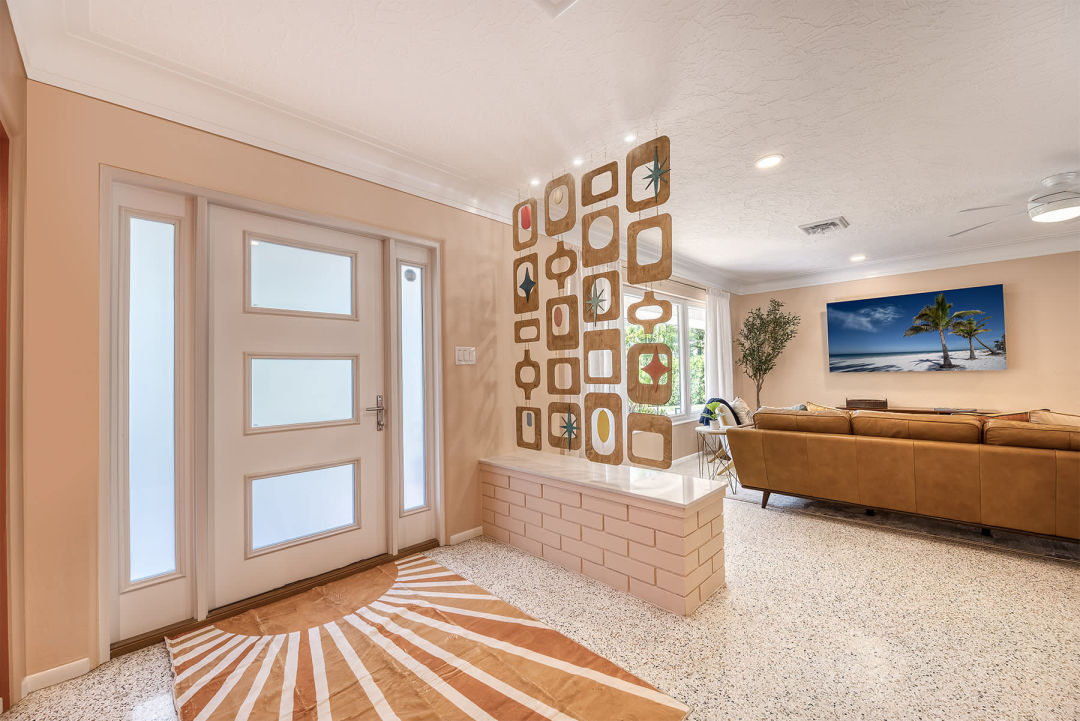
Image: David Bruce Kawchak
Beth Breeden noticed that steadiness the first time she stayed here, back when the house was operating as a short-term rental owned by other investors. She was a guest then, not yet its owner.
“I saw it in April of 2025,” Breeden says. “When I got there, I just stayed. We never really left.”

Image: David Bruce Kawchak
Breeden, a Minnesota-based flight attendant with Sun Country Airlines and a freelance graphic designer, bought the house the very next month as her first short-term rental investment after selling 40 acres of farmland in Idaho. She had looked elsewhere—Bradenton, properties closer to the islands—but kept returning to this one. The decision, she says, was both practical and intuitive.
“It’s one-level living,” she says. “I’ve always lived in multilevel homes with stairs. If I were going to buy an investment, it had to be one level. I like open floor plans too.”
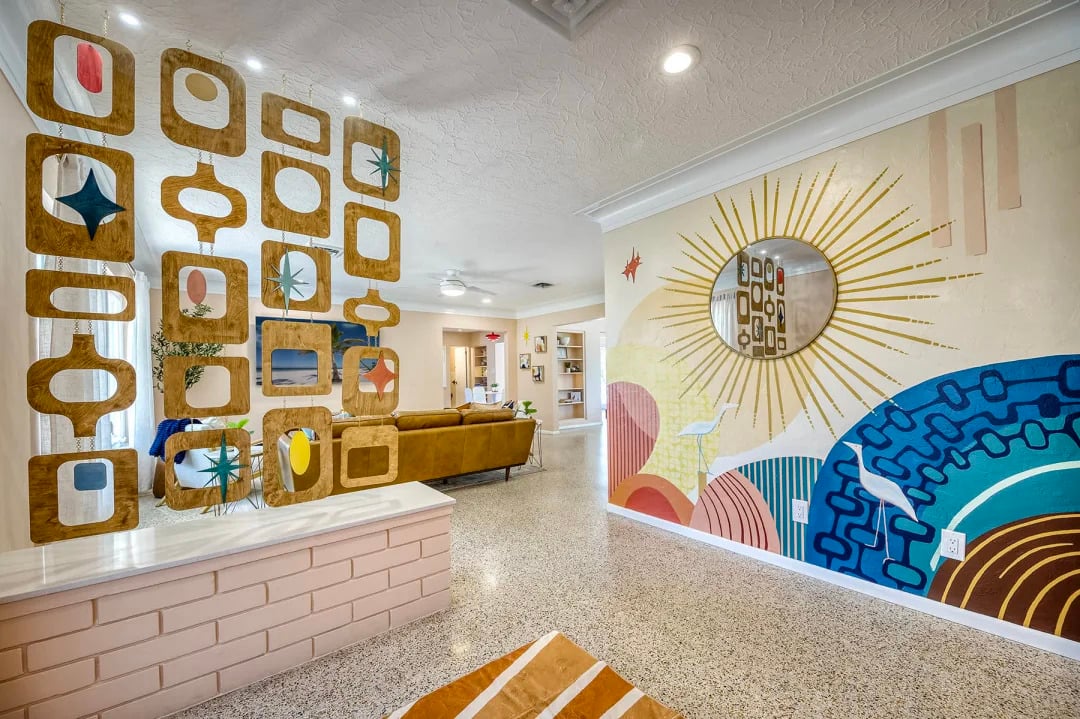
That openness defines the interior. Terrazzo floor runs continuously from entry to living room to dining space to kitchen, visually binding the house together. Sight lines stretch across rooms, with furniture arranged to encourage gathering rather than separation. A long leather sofa anchors the living area, paired with sculptural chairs and low tables. Light filters in through sheer curtains—generous, but controlled.

Image: David Bruce Kawchak
The entry itself is less a foyer than a pause. A low brick planter, original to the home, now supports a suspended wood divider composed of geometric cutouts, custom-made by local engraver Jennifer Slack of Banyan Tree Creations. The divider separates space without closing it off, introducing the house’s midcentury logic immediately: structure without heaviness and definition without walls.
Interior designer Millie La Vasseur, who works with BNB Gulf Coast Hospitality Hosts and has spent roughly a decade in the short-term rental industry, leaned into those bones.
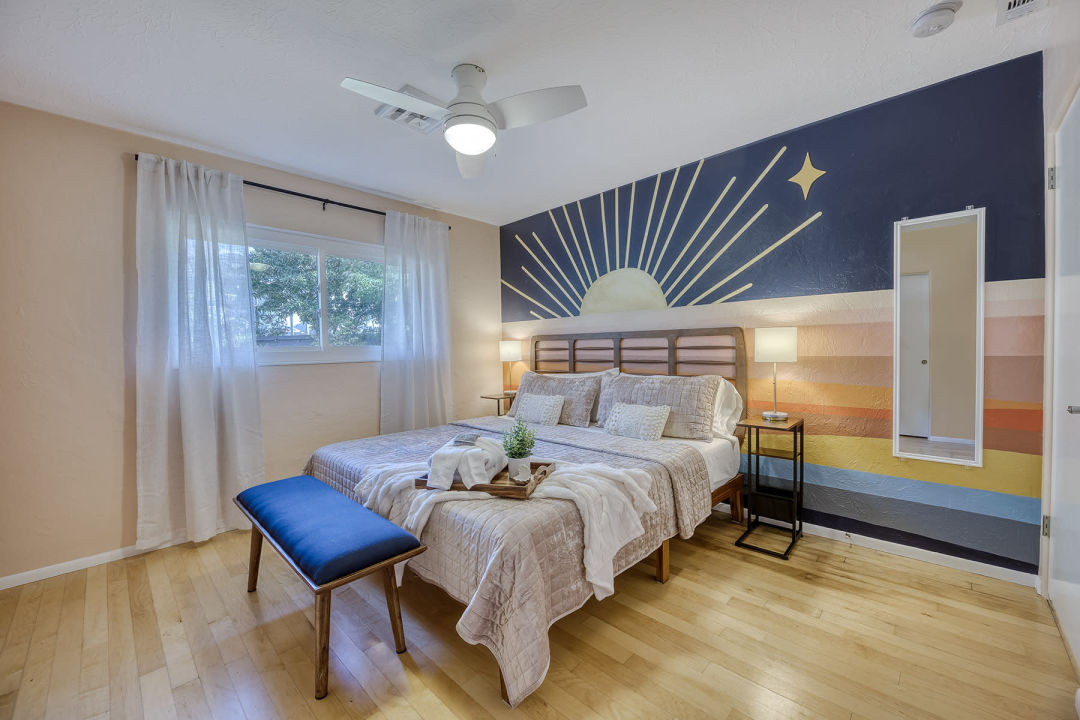
Image: David Bruce Kawchak
“The architecture of the home already lends itself to midcentury,” La Vasseur says. “The windows, the terrazzo—it was already there and we didn’t want to cover that up.”
Instead of defaulting to a coastal theme—you know, the blues, whites and seashell motifs that often initially seduce northern transplants—La Vasseur proposed something more contextual. The house sits near the Ringling Museum and Sarasota’s long design lineage, surrounded by eclectic homes and quiet streets.
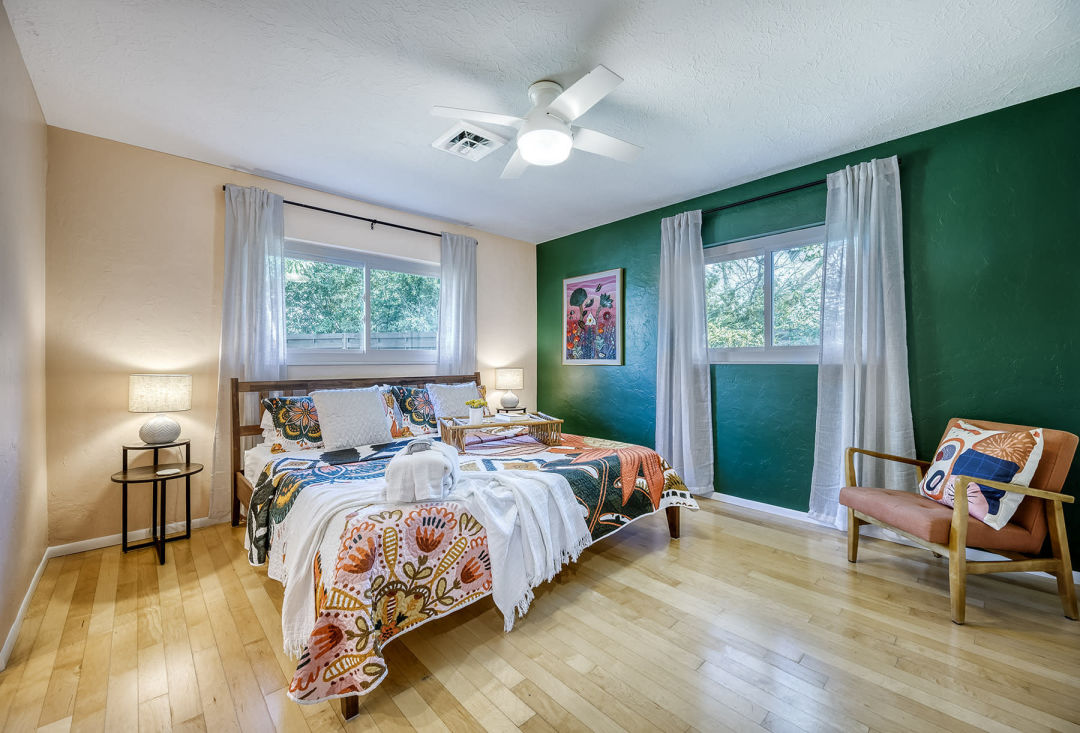
Image: David Bruce Kawchak
“Here, we wanted something super cool you might not do in your own home,” La Vasseur says.
That confidence shows up in moments of restraint and risk. In the family room, patterned wallpaper hugs the ceiling—a move that could overwhelm, but doesn’t. So as not to interrupt it, the ceiling fan is built into the light itself–a circular LED band, with the fan blades concealed inside the ring–powerful, but nearly invisible.

Image: David Bruce Kawchak
The kitchen, finished in glossy red cabinetry with glass-front uppers, predates Breeden’s ownership. Installed in 2008 during previous owners’ tenure, its a striking punctuation mark in the house. It’s still in great shape.

Image: David Bruce Kawchak
Bedrooms continue the theme of individuality. Breeden removed the previous configuration of multiple single beds—one room, she says, felt “like a hospital”—and replaced them with king beds in each room. Each is positioned beneath windows to frame views of lush, tropical greenery outside.
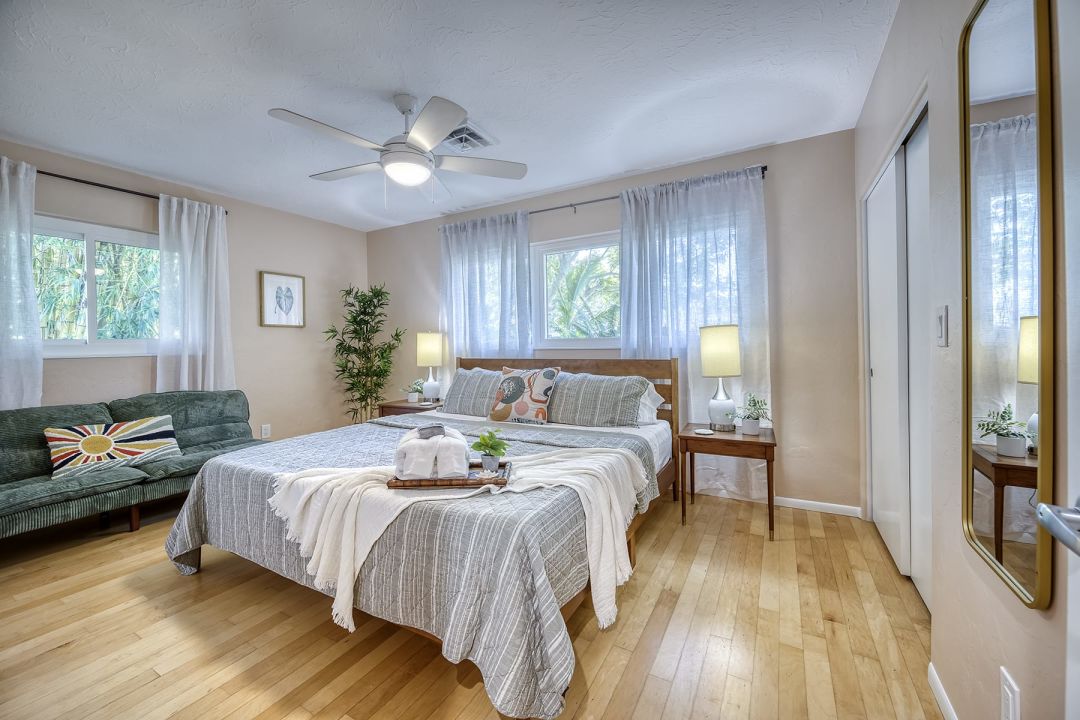
Image: David Bruce Kawchak
“I wanted the beds under the windows so you could see the bamboo,” Breeden says. “There’s this cluster that turns orange. I kept thinking, ‘Did it come from Japan?’ The previous owners lived there.”
Murals appear throughout the house, but they function less as decoration than as spatial anchors. A sunrise mural stretches behind a floating headboard in one bedroom. Another room uses a deep green accent wall to ground the space. The murals, painted by local artist Corin Finnie, share a visual vocabulary of horizon lines, sunbursts and geometric repetition.

Image: David Bruce Kawchak
“I told Millie I wanted murals because people love photo ops,” Breeden says. “Millie gave Corin a black-and-white image of Bayfront Park, and she took off with it.”
La Vasseur describes the approach as collaborative but disciplined.
“We tried to make each room different, but cohesive,” she says. “The murals, the divider the furniture silhouettes—they all speak to each other.”
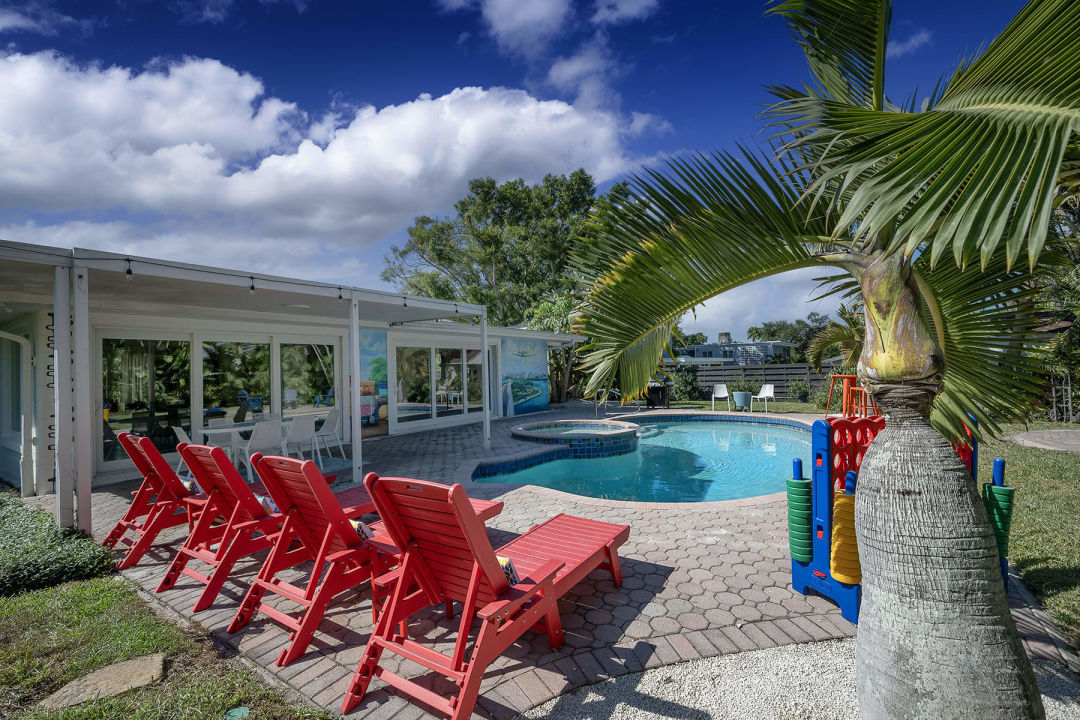
Image: David Bruce Kawchak
Before the midcentury mod makeover, for nearly seven decades, the house has absorbed a succession of lives that mirror Sarasota’s cultural and civic crosscurrents. Built in the late 1950s, it was first owned by husband and wife, Brigadier General Elliott R. Thorpe and Emily Thorpe. Thorpe, a decorated World War I and World War II veteran and career intelligence officer, retired to Sarasota after decades of service that placed him at some of the twentieth century’s most consequential moments. During his retirement in Sarasota, Thorpe wrote his memoir, East Wind, Rain, and remained active in the Whitfield community, where he was instrumental in the early years of the Whitfield Volunteer Fire Department. Neighbors remember him as much for his daily rituals—tending trees and guarding a macadamia nut tree from squirrels—as for his formidable résumé. Thorpe died in 1989 and is buried at Arlington National Cemetery; his wife Emily predeceased him.
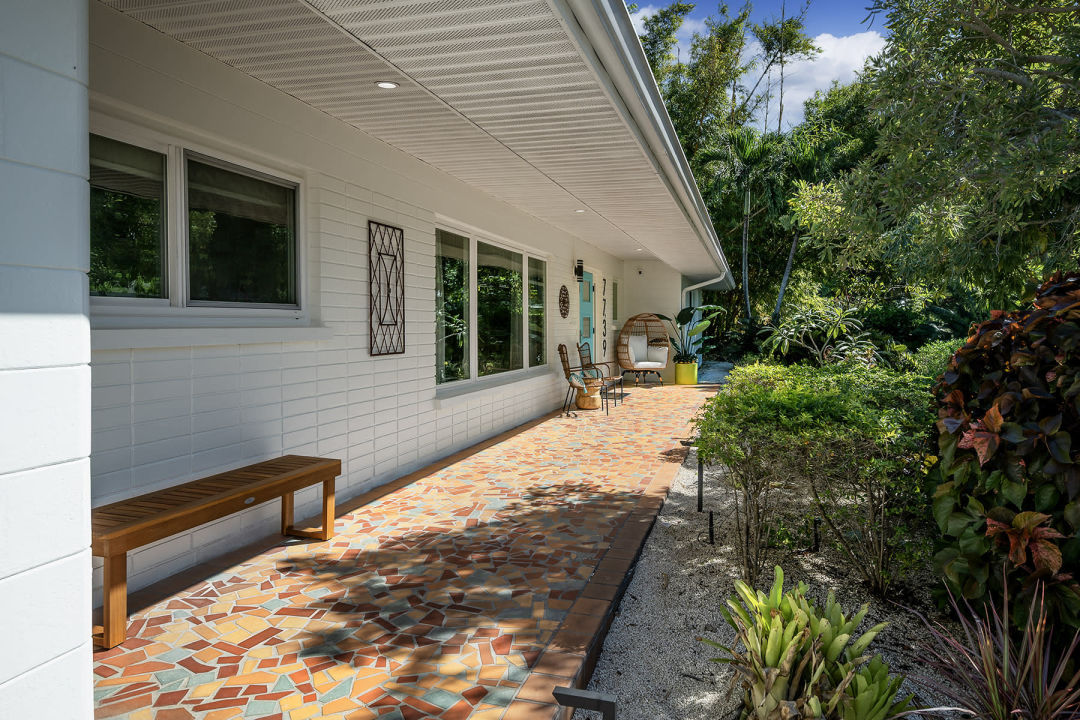
Image: David Bruce Kawchak
In the 1990s, the home passed to Bent and Cristina von Cotta Schonberg, bringing a different kind of discipline into the space. Bent Schonberg, an internationally respected dance critic and author, spent decades chronicling and advocating for the Royal Danish Ballet before retiring to Sarasota, where he co-founded the Ballet Society of Florida. He died in 1999, and Cristina remained in the home for several years afterward. From 2001 until 2019, the house was owned by Gregory and Eleana Hall, who were deeply embedded in Sarasota’s design and civic life. Gregory Hall founded Hall Architects in 2003 and served as its president and principal architect; Eleana, a CPA, volunteered extensively in the community, including with Easter Seals. During their tenure, the kitchen and primary bathroom were renovated in 2008, introducing that now-iconic red kitchen (which was later featured on HGTV). Gregory Hall died in June 2019 and Eleana Hall died later that same year. Neighbors recall a period of profound loss that marked the end of a long chapter in the home’s life.

Image: David Bruce Kawchak
Now, the home has a new steward. Breeden’s career keeps her in near-constant motion, crossing time zones and schedules. The home’s proximity to Sarasota Bradenton International Airport is practical, but it also mirrors her own relationship to travel—departures followed by deliberate landings. That connection appears subtly inside the house, where an airplane mural nods to flight without turning the space into a theme. It reads less as decoration than as biography—a reminder that for someone whose life unfolds largely in the air, home is defined by what brings you back down.
Outside, the house expands rather than ends. A terrazzo-tiled walkway traces the exterior, connecting seating areas shaded by palms. An outdoor shower becomes a small gallery moment, its wall painted with the city of Sarasota’s at times controversial symbol of David, rendered in soft blue tones. Beyond it, the pool curves gently across the yard, flanked by red lounge chairs and a covered dining area.
A large mural stretches across the back of the house, depicting Sarasota’s bayfront skyline beneath a radiant sun. Sliding glass doors dissolve the boundary between inside and out.
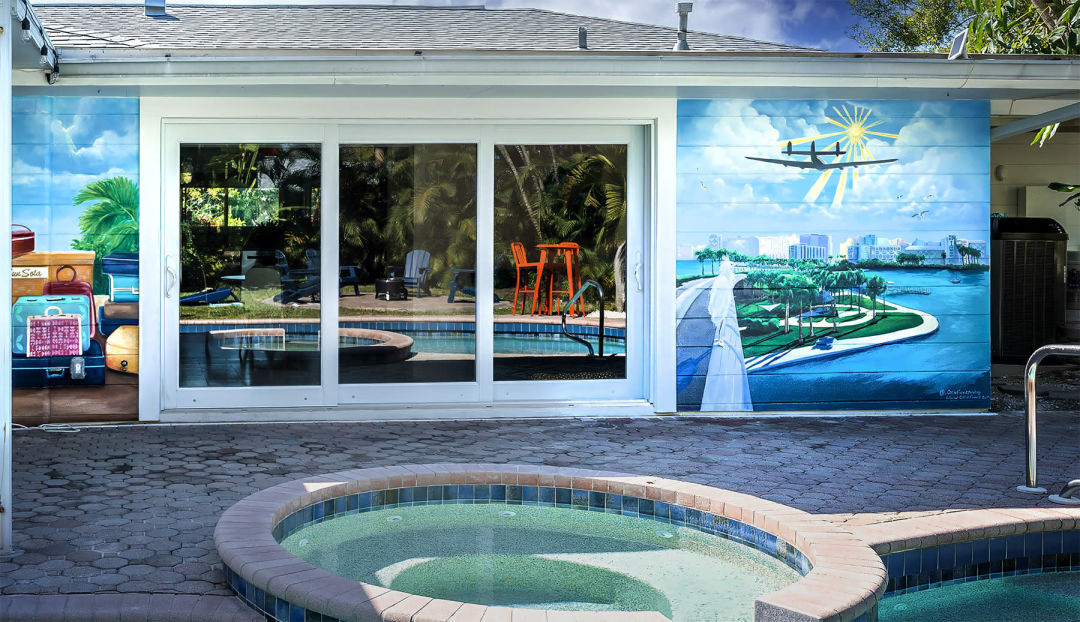
Image: David Bruce Kawchak
“The outdoor rooms are just as important as the inside,” La Vasseur says.
That sense of continuity matters to her.
“I bought this house to spend time together,” she says. “For my family and friends to come down and host get-togethers. It’s better than a field of dirt. The land wasn’t doing anything.”
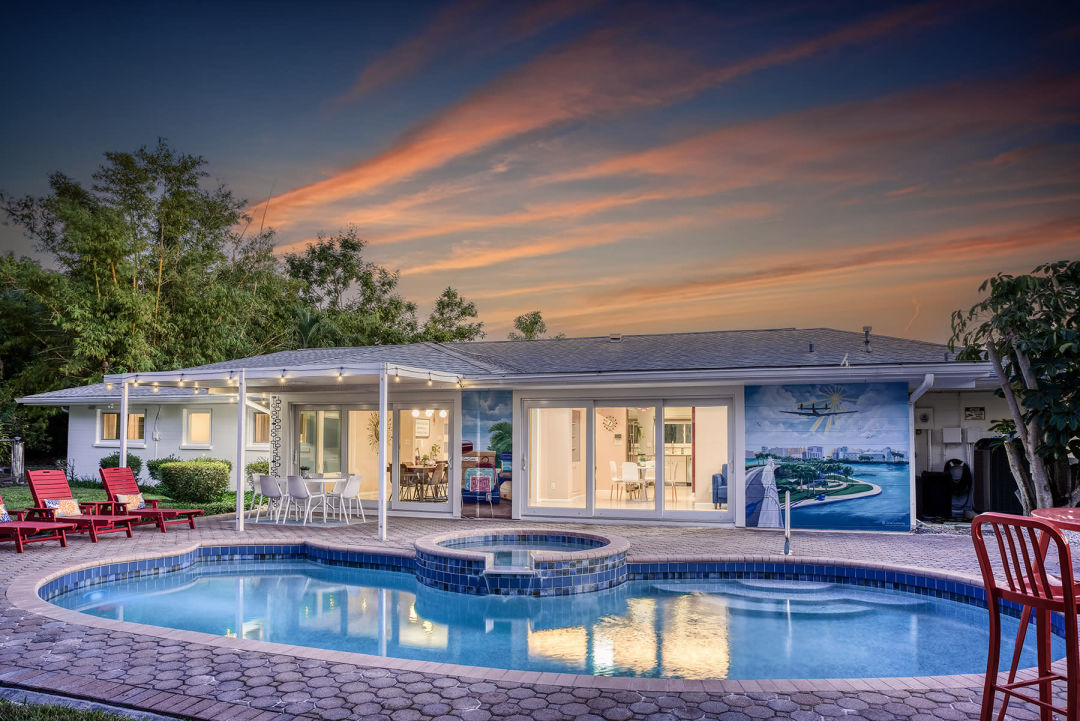
Image: David Bruce Kawchak
Breeden grew up on a farm in northwest Iowa, a place where space was functional and shared. That sensibility carries through here—in the open rooms, the long tables, the places designed for people to sit without urgency.
“It’s not just a home,” La Vasseur says. “It’s something people feel when they’re here.”
In a city where midcentury architecture is often flattened into nostalgia, this house remains active. It hosts families. It absorbs art. It remembers its past without being trapped by it.







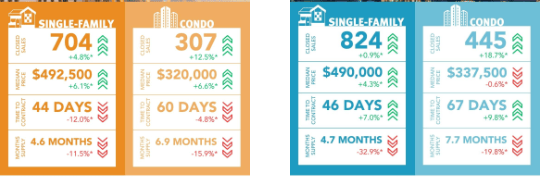
Sarasota Real Estate Market Update August 2025: Buyers Stay Active as Back-to-School Season Begins















A rare opportunity to own a piece of Sarasota design history—fully updated for today’s lifestyle.

Explore the latest Sarasota real estate market trends for Feb 23 – March 1, 2026. See updates on pending sales, closed transactions, price changes, and buyer activity … Read more
How to Prep for a Mortgage Before You Fall in Love With a House


Freezing = anything that requires a jacket we forgot we owned









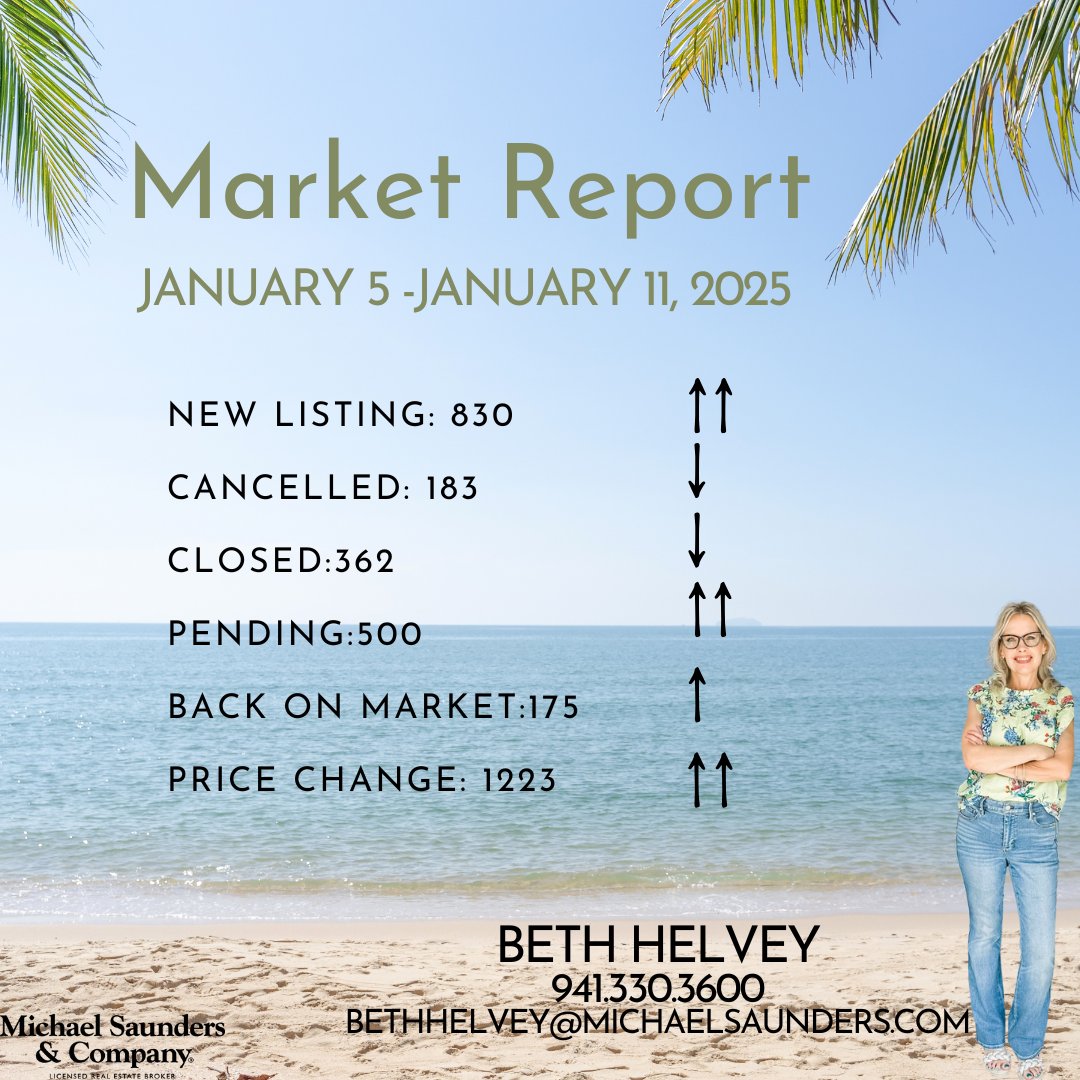
Market Report for January 5-11,2025






















I’d love to hear from you! Whether you’re buying, selling, or just exploring your options, I'm here to provide answers, insights, and the support you need. Contact me and start planning your next move.