
A midcentury bathroom presents a particular renovation dilemma. Gut it and you erase the period character that gives the whole house meaning, but leave it as is and you often end up with something too small, too worn, or too inflexible for contemporary life. The question designers are asking is: How do you honor the soul of a postwar bathroom while making it livable for today?
The recent restoration of a 1952 Los Angeles home designed by Paul R. Williams for himself and his wife (featured in AD’s March 2026 issue) offers a lesson in exactly that balance. Williams had a talent for designing the personal spaces in a home that guests usually don’t see: dressing rooms with fitted cabinets at exactly the right height, generously sized bedrooms, and colorful bathrooms with sophisticated artistic details. When approaching the renovation, architects Frank Escher and Ravi GuneWardena of Escher GuneWardena Architecture in Los Angeles found themselves faced with a puzzle on the home’s second floor.

Though the new owners were committed to preserving as much original detail as possible, the primary bathroom was on the small side. To keep the structure intact while providing more space for the bathroom, Escher and GuneWardena made ingenious use of a previous renovation: Mrs. Williams’s personal hair salon. Though not a feature that every postwar modernist home is likely to have, in this circumstance it provided the perfect bridge to a new, historically-minded interaction for the home’s second floor.
The solutions they came up for the two bathrooms apply to any midcentury home whose bathrooms deserve better than a generic refresh.

Let the original house’s palette lead
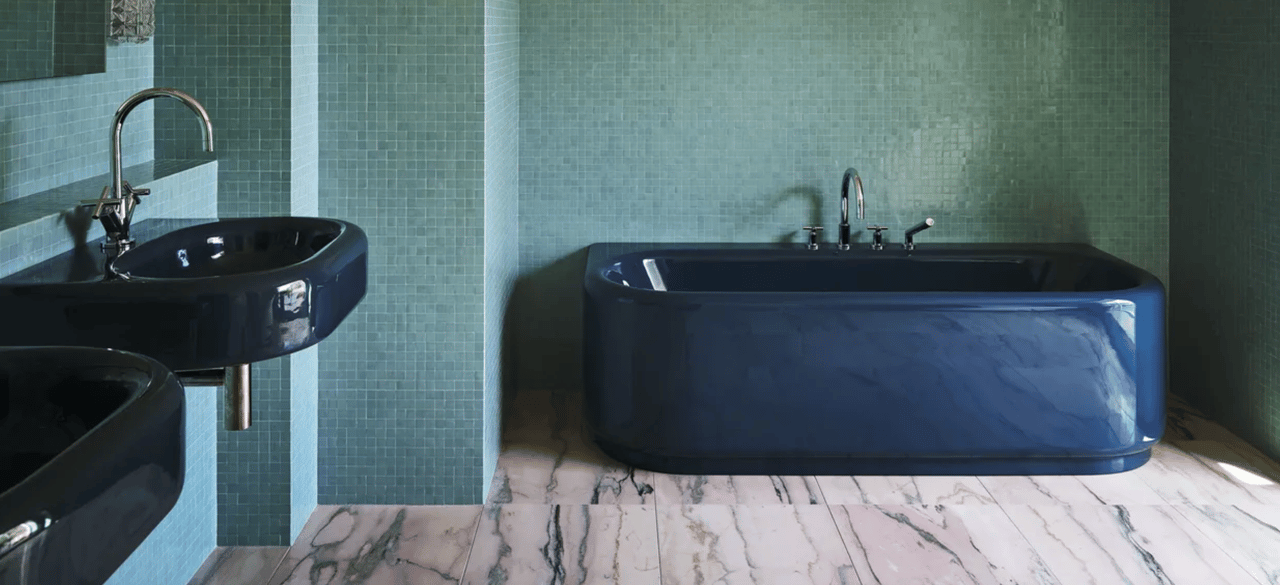
Williams was known for his deft use of color throughout his residential work. Rather than defaulting to the whites and chrome that reads generically as “midcentury,” Escher and GuneWardena pulled from the chromatic sensibility already present in the house. The result—rose and gray-veined marble, aquamarine Bisazza glass mosaic tile, and deep-blue fixtures—feels period-specific without being literal reproductions. “The color scheme makes a reference to Paul Williams’s deft use of color, as found in other places in the house and, in fact, throughout his career,” Escher tells AD PRO.
For any midcentury renovation, this suggests a method: audit the colors the original architect used in other rooms—whether it’s the terrazzo floors, painted millwork, or tile in secondary bathrooms—before selecting a finish for the bath. The palette is often already there.
Choose fixtures that feel of-the-era without being of-the-archive
The plumbing fixtures in the Williams house, designed by India Mahdavi for Bisazza—including a lapis-blue bathtub—achieve something harder than it looks: They read as vintage glamour without looking like salvage. “The tub, sinks, and plumbing fixtures have a classic, timeless elegance,” says GuneWardena.
This is one of the more practical decisions designers face with midcentury bathrooms: whether to source original period fixtures, find new-old stock, or select contemporary fixtures with period resonance. The Williams restoration makes a case for the third option when done with care—vivid, saturated colors in a confident form can feel more authentically midcentury than reproduction hardware.
Work with the existing floor plan, not against it
One of the most instructive moves Escher and GuneWardena made was recognizing that the modest hair salon Mrs. Williams added to the house in 1980 could be reimagined as primary bathroom space. “While the house was built with an extraordinarily beautiful dressing room, the original primary bath itself was modestly scaled,” says Escher. “We used the footprint of this addition to develop a new primary bathroom, a space distinctly of its time, but better suited to the scale and refinement of the original house—a balance that was important to find.”
The lesson here isn’t that you don’t need a vintage salon waiting to be repurposed. It’s that later additions or adjacencies can often absorb the square footage a midcentury bathroom needs without requiring you to alter original walls or volumes.
Sweat the geometry of tile and surface alignment
Perhaps the least glamorous but most telling detail in the Williams restoration is this: “Every aspect of the addition, including the tile pattern, was thoroughly worked out, both on paper and in the field. Walls were carefully aligned with the geometry of the tile grids.” In a midcentury interior, where so much of the visual logic depends on clean lines and considered proportion, misaligned tiles or surfaces that don’t respond to existing geometry will read as wrong even to a non-designer’s eye.